
The hardest part about buying leather for the first time is that most websites blur together two very different questions. They conflate performance and aesthetic characteristics, or worse, they focus on one and ignore the other. But you need a feel for both.
You need to understand what a leather is good for (how it will perform in the world) and what it looks like and communicates when you hold it in your hand. Those two dimensions are always intertwined, but they are not the same thing.
Historically, these differences were easier to grasp because the language of leather was rooted in specific trades. Terms like latigo, harness, and bridle emerged from saddlery and horse tack. They conveyed something about structural expectations, temper, and finish. While those categories encompass a wide range of materials and processes, they are grounded in real working traditions.
Other traditions developed their own naming conventions. Upholstery leather, garment leather, bag leather, Italian vachetta. Each signals a blend of performance expectations, temper, and surface character. The problem is not that these terms are wrong. It’s that they don’t always share a common frame of reference.
Our goal in writing this guide is to provide you with precisely that: a common frame of reference, a way to think about leather as a first-time buyer. We introduce what we call the Surface Story and the Working Story of leather. Every article exists somewhere along these two axes. We find their relative positions by asking a couple of simple questions:
- How much does the leather’s surface communicate about the life of the animal versus the finished product in which it is used?
- How much is the leather intended for personal use, possibly a source of daily joy, versus serving a more industrial purpose?
An article like Alran’s Sully and one like Horween’s Aspen are very different, but thinking about their possible applications (Working Story) and how they look and feel (Surface Story) helps us evaluate their fit for our own projects. Over time, it also helps us build an internal model of what different tannages and finishing processes mean in practice.
The second goal of this guide is practical: to give you a few concrete recommendations you can safely start with. These are beautiful leathers that reward your effort. Too many beginners start with a scrap from a discount bin. A malformed belly or a random panel of upholstery leather that won’t burnish, edge, or assemble into anything coherent will drive you mad and teach you very little.
Choose one of the six leathers noted here (ideally one of the first three) and expand your horizons from there.
The third point is more of a strongly held opinion than a defensible argument: you deserve good tools and good leather.
It’s tempting to begin with something cheap. After all, you’re going to make mistakes. You might not even like leathercraft. But this logic quickly becomes self-fulfilling. Trying to bevel a crumpled piece of low-grade chrome-tanned scrap with a dull, off-brand beveler is discouraging. It’s difficult to learn well on sacrificial material, and there is no real reward for doing a careful job when the finished object is destined for the bin.
By contrast, making something from Pueblo, more on that below, with quality tools feels good from the start. The process itself becomes rewarding. Improvements are visible. The feedback loop tightens. I promise: you will want to make the next thing. A few quality tools, a shoulder of fine leather, and a simple project to iterate on are, I think, enough to fall in love with the craft.
One more opinion. Leathercraft is an ancient tradition with extraordinary depth. Approach it with humility, patience, and a desire to make beautiful things, and before long, you will.
On to the graph!
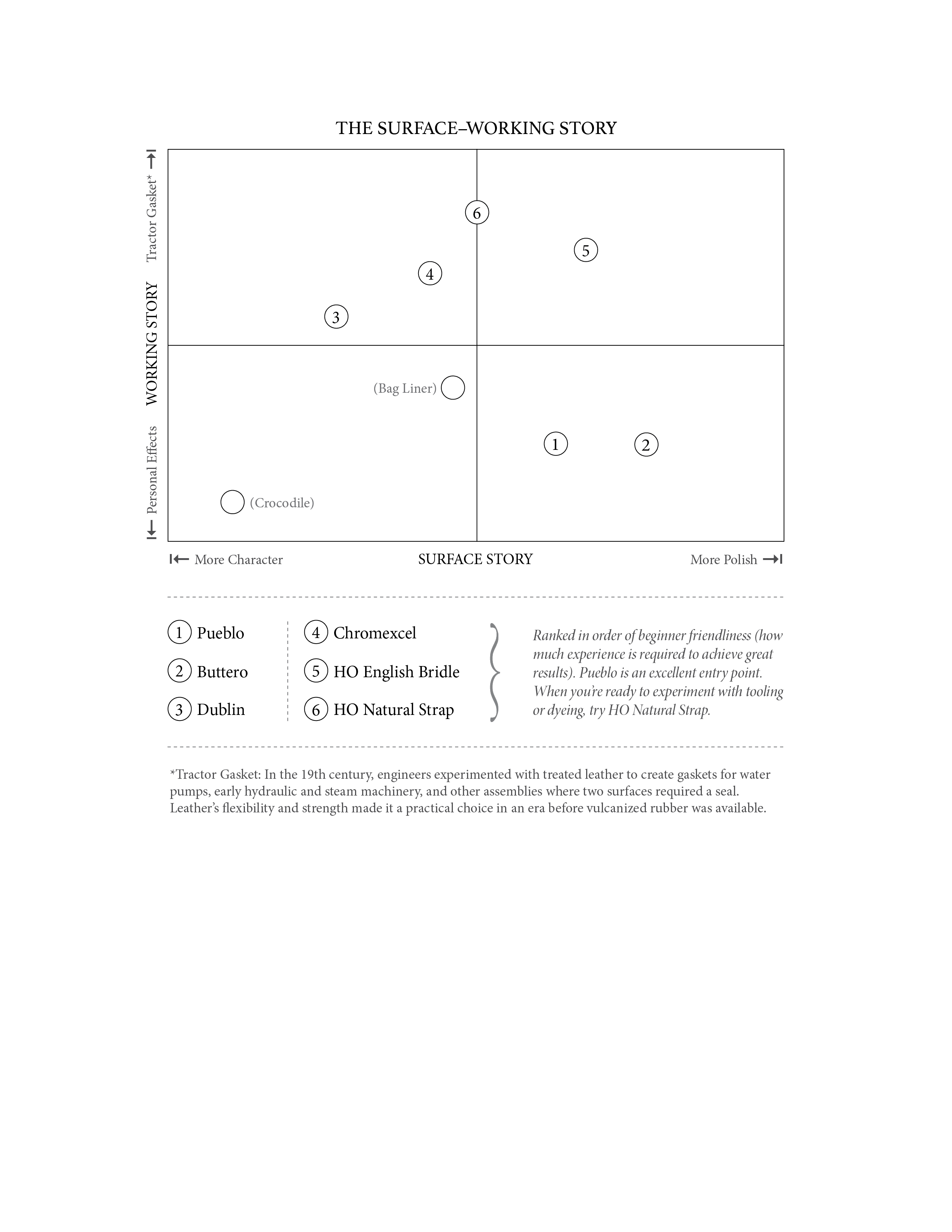
It is tempting, at first glance, to simplify the graph. One might reduce the horizontal axis to something like rustic versus elegant, and the vertical axis to weak versus strong. But those reductions miss what is most interesting about leather.
The left side of the Surface Story axis is not simply “rough.” It represents the degree to which a maker chooses to disclose the history of the hide itself. Some of the finest and oldest English bagmakers in the world make this choice deliberately. Swaine, for example, is known to use shoulders with pronounced fat wrinkles as bag flaps, carefully aligning those wrinkles across the width of the piece to striking effect. The result could not look more elegant, and yet it openly reveals something about the life of the material. Character and refinement are not opposites. They are compositional choices.
Likewise, the Working Story axis is not a simple spectrum from weak to strong, though strength is certainly one of the qualities we evaluate. Other factors matter just as much: resilience, dimensional stability, flexibility, the ability to bond with other materials, and how the leather behaves under tension and over time. More importantly, the axis asks a different kind of question. Is what we are making meant to become part of our personal, daily life, or is it intended to serve a more overtly productive function beyond ourselves?
A wallet and a belt may both be strong. But we expect them to perform differently. One is handled constantly and lives in a pocket. The other must resist stretch, carry weight, and hold shape under sustained load. The distinction is not merely mechanical. It reflects how we imagine the object entering the world.
Before going further, it is worth stating the obvious: this is not intended to be a comprehensive guide to leather. There are thousands of leathers available from hundreds of reputable tanneries. What follows is a focused framework, built around six widely respected articles, chosen for their diversity, their breadth of application, and how rewarding they are to work with.
You will also notice that we have excluded chrome-tanned leathers from this small sample set. That choice is intentional. High-quality chrome-tanned leathers absolutely have their place in leathercraft and can open up an entirely different approach to making. There is no categorical hierarchy between vegetable-tanned and chrome-tanned leather. But there are better materials to learn on: “high-quality vegetable-tanned leather is, without question, the superior teaching medium.”
The relative firmness of most veg tans makes it easier to practice stitch tension and alignment. The fiber density at the edge allows you to learn skiving and beveling, which are foundational skills. You can make simple, practical objects such as card holders and belts that are not only exercises but real, shareable accomplishments. Veg tan also makes it easier to feel the difference between cuts from different areas of the hide. That sensitivity is part of developing judgment.
It is possible to experience some of this with chrome-tanned leather, but the softness of the fibers and the variability even within a single hide demand more experience. Chrome excels when your goal is to machine stitch a tote and paint the edges. But if your goal is to handcraft a refined leather object, you must first ground yourself in the basics.
As for the graph itself, one could quibble with the precise placement of each dot. I think that’s part of the fun. But the ordinality along each axis is deliberate. Buttero and English Bridle, for example, may seem worlds apart when described by their respective tanneries, yet here we see that both occupy the highly finished end of the Surface Story spectrum. Their densities and structural characteristics differ significantly, but their aesthetic refinement places them in conversation with one another.
In the sections that follow, we explore these six articles in more detail. The hope is not that you memorize their specifications, but that you begin to sort what you read online into two categories. What is being claimed about how the leather performs, and what is being claimed about how it looks and feels? Once you begin thinking in those terms, marketing language becomes easier to decode.