
Colonial Foundations and Early Leather Trade
Leatherworking in New England began with the region’s earliest inhabitants. Indigenous people had well established traditions of preparing animal skins for use in clothing and shelter before European settlers arrived. The English colonists introduced European practices for treating hides with the tannins from local trees like oak and hemlock. Buckskin became the basis for a lucrative transatlantic trade and a valued material for goods like rugged britches, blacksmiths’ aprons, footwear, gloves, hats, and ammunition pouches. By 1639, a tanner named Philemon Dickerson in Salem (present-day Peabody, MA) was granted land to dig tanning pits and process hides; it was one of the first recorded tannery operations in Massachusetts.
Colonial governments tightly regulated tanners because leather was so vital. As early as 1640, Massachusetts could fine any tanner who failed to properly salvage and cure hides. Tanneries needed water and isolation (due to their odor), so they often set up on the outskirts of communities or along rivers and coves. Concerns for managing the olfactory pollution were so strong that in 1641 the city of Boston let two men sink a tanning pit by one mill pond on condition that they refill it if the smell became too offensive. Throughout the 1700s, nearly every New England village had its local tanner who would cure farmers’ hides (often taking a share of the leather as payment). Larger settlements would support the profession by sinking their own tanning vats and renting them to tanners for a period of seven years. By 1770, the craft had expanded enough that officials in Danvers (today’s Peabody) were issuing official seals to local tanners, signaling the trade’s economic significance. Leather was truly a cornerstone of the colonial economy, critical for clothing, footwear, bookbinding, military gear, and more, and New England’s abundance of livestock and bark (for tannin) made it a natural center for the industry.
Rise of an Industry: 19th Century Tanneries and Shoemakers
In the 1800s, New England’s leather industry grew from small-town tanneries into a network of major production hubs. Many towns became known for either tanning leather or crafting leather goods (and sometimes both). Peabody, Massachusetts (formerly South Danvers), with its flowing rivers and ample oak forests, emerged as a powerhouse of tanning. By 1855, that town boasted 27 tanneries and 24 currying shops (which processed tanned hides into finished leather), a concentration of leather businesses virtually unmatched in the young nation. Nearby Woburn, MA had a similar rise: after the Middlesex Canal opened in 1803, Woburn developed dozens of tanneries along streams like the Aberjona River. By the 1860s and 1870s, Woburn had more than twenty active tanneries employing hundreds of workers and processing thousands of hides weekly. The region’s thriving shoe industry also took off in tandem. Lynn, Massachusetts became one of America’s first shoe-manufacturing centers, known for producing boots and shoes on a large scale as early as the 1820s and 1830s. In 1850, about 80% of the leather produced in the United States was used to make footwear, with finer leather for the uppers and thick cowhide soles.
As the Civil War approached, Lynn was the major hub for shoe production, and many other Massachusetts towns like Brockton, Haverhill, and Newburyport followed suit with shoe factories of their own. This boom in shoemaking drove demand for leather even higher. In fact, the Civil War itself initially caused a downturn in New England tanning (due to economic uncertainty), but soon the war’s demand for boots, saddles, and harnesses created a surge in business. Peabody’s tanneries, for example, rebounded strongly after the war by supplying leather to the booming shoe factories in nearby Lynn. By 1870, Peabody was one of the nation’s leading leather producers, while Woburn competed with Lynn (and even Philadelphia) for leadership in the American shoe market. The symbiosis was clear: coastal Massachusetts supported an integrated leather economy, where some towns specialized in turning raw hides into leather, and others specialized in turning that leather into finished goods like shoes, boots, horse tack, and industrial belting.
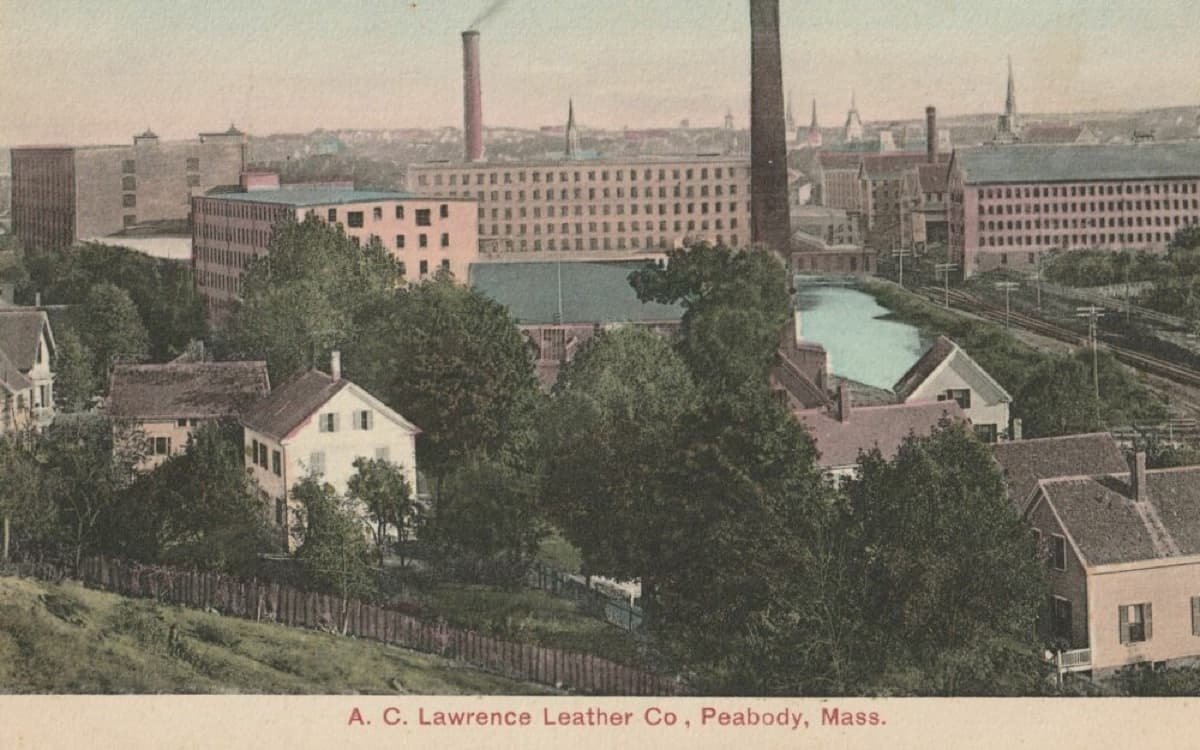
By the late 19th century, New England could claim some of the largest leather enterprises in the world. A pivotal figure was Arthur C. Lawrence, who in 1894 consolidated several Peabody tanneries into the A. C. Lawrence Leather Company. His company employed thousands of workers and soon became the world’s largest producer of calf and sheepskin leathers. Peabody proudly adopted the moniker “Leather Capital of the World,” and by 1919 it was recognized as the globe’s #1 leather-producing city. At that peak, Peabody’s leather district hosted 91 separate establishments devoted to tanning and leather processing. Other Massachusetts communities also thrived: Salem and Beverly had notable leather factories. In southern Maine the town of Kennebunk boasted a huge tannery as well. Wherever there were slaughterhouses or fisheries (for hides and skins) plus water and timber (for bark), a tannery was likely nearby. By the turn of the 20th century, the region had become a leather epicenter, supplying not only local needs but also shipping leather across the United States and abroad. Boston, as the region’s commercial hub, played a key role in this ascent, a role that would soon be cemented in brick and stone after a great urban fire.
Boston’s Leather District and Urban Hub
Boston itself benefited immensely from the leather and shoe trade, even if much of the actual tanning happened in outlying towns. In the early 1800s, many larger shoe and leather manufacturers from surrounding towns began opening offices and warehouses in downtown Boston. The city became the financial and distribution center for New England’s leather goods: buyers from around the country would come to Boston to source hides, finished leather, and footwear. By the mid-19th century, most of the leading leather merchants had set up shop in a part of Boston known as the South Cove. Then disaster, and opportunity, struck in 1872 when the Great Boston Fire ravaged the downtown business district. In the aftermath, city officials enacted strict fire codes for new commercial buildings. Leather wholesalers and tanners, whose trade required large storage spaces, seized the chance to build modern, fire-resistant structures on the South Cove land.
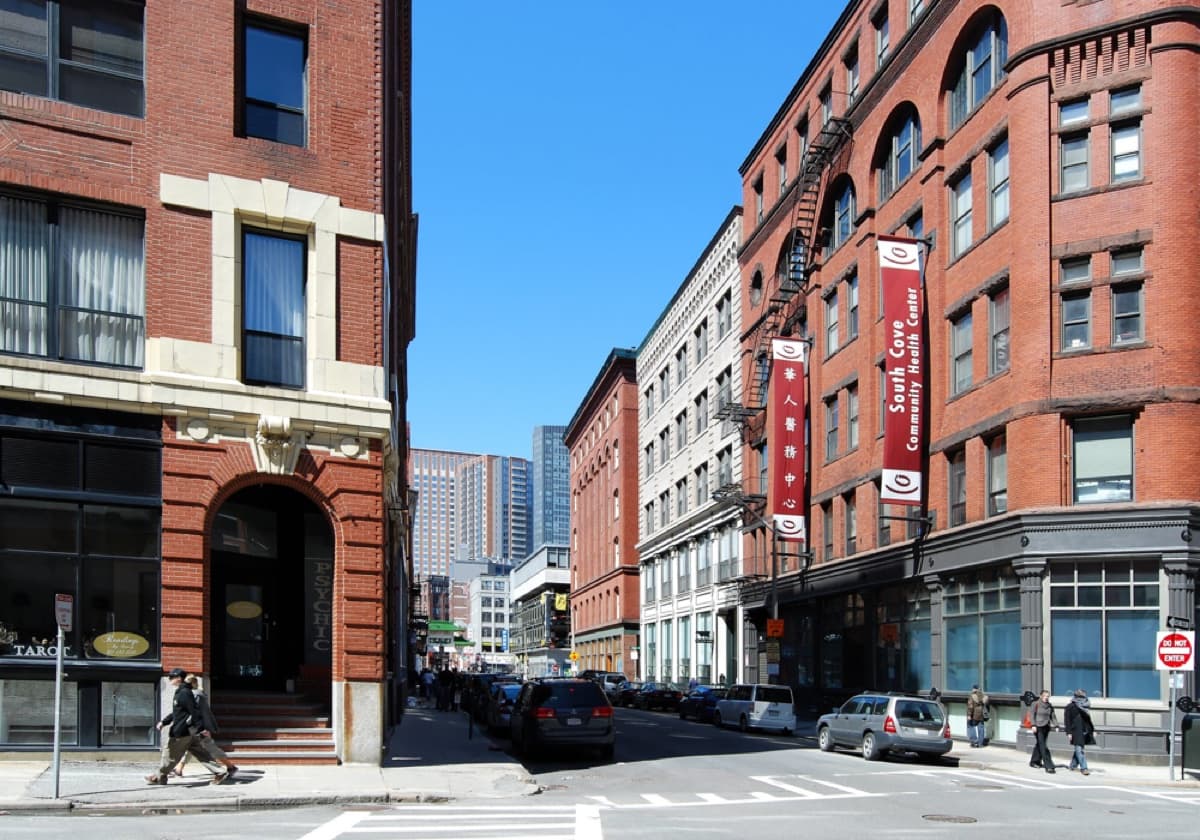
Thus was born Boston’s Leather District in the 1880s, a nine-block area of sturdy brick warehouses between Kneeland and Essex Streets that became the heart of the city’s leather trade. Ground-floor showrooms along streets like South and Beach Street displayed leather hides and samples, second-floor offices handled deals, and the upper floors were packed floor-to-ceiling with skins, hides, and finished leather waiting to be sold. The new buildings were often architect-designed (the firm Peabody & Stearns and others contributed to the distinctive Romanesque Revival look of the area) and optimized for the leather business. By the late 19th century, this district was booming; Boston had solidified its role as the trading nexus for New England’s leather output. The United States Leather Company, a nationwide trust that controlled many tanneries, even maintained a large warehouse here around 1901. For decades, “the Leather District” was a bustling marketplace where rustic hides from New Hampshire farms or Midwestern stockyards might arrive by rail, get stored and sold via Boston brokers, and then be shipped off to a Lynn shoe factory or a Peabody tannery for finishing. Today, the Leather District’s handsome 19th-century warehouses still stand (mostly converted into offices and residences), their historic facades a reminder of Boston’s bygone leather economy.
Workers, Immigrants, and Labor Struggles
From the start, leatherworking was a tough trade performed by skilled craftsmen and laborers, and over time, a diverse immigrant workforce. In colonial days, tanning was often a family business passed from master to apprentice, and every tannery yard needed numerous hands for the hard manual tasks of hauling water, grinding tree bark for tannin, scraping hides, and stirring foul vats. (It was not uncommon to see boys as young as 8 or 10 working in tannery yards, grinding bark or cleaning hides as apprentices.) As the industry scaled up in the 19th century, it attracted waves of new Americans. The work may have been dirty and pungent, but it was a livelihood. By the late 1800s and early 1900s, New England tanneries and shoe factories were a melting pot of ethnic communities. Immigrants from Ireland, Italy, Canada, and later Eastern Europe and the Ottoman Empire (Armenians, Greeks, Turks, Poles, among others) filled the ranks of the leather trade. For example, Peabody’s booming leather mills drew workers from at least 21 different countries by 1910, including large Armenian and Polish communities that settled there. These workers not only contributed skill and sweat, but also shaped the social fabric of industrial towns, building churches, benevolent societies, and neighborhoods often tied together by the common bond of leatherwork.
With the growth of this labor force came early stirrings of labor organization in the leather trades. A landmark moment occurred in 1860, when Lynn’s shoe factories were rocked by what became the largest strike in America up to that time. Beginning on Washington’s Birthday in 1860, some 3,000 Lynn shoemakers (men and women) walked off the job, protesting wage cuts and grueling 16-hour workdays. The strike spread to other New England shoe towns, eventually involving tens of thousands of workers across Massachusetts and beyond. Remarkably, women played a pivotal role in this movement, female shoe stitchers organized and marched by the hundreds in Lynn, even during a snowstorm, demanding fair pay for their piecework. This uprising gave birth to the first national women’s labor union in the United States: the Daughters of St. Crispin, founded in Lynn in 1869. (St. Crispin, fittingly, is the patron saint of cobblers, tanners, and leather workers.) The Daughters of St. Crispin, along with their male counterparts in the Knights of St. Crispin (a shoemakers’ union), fought for better wages and conditions in New England’s shoe shops and won some early victories, including successful strikes for higher pay in 1872 in Massachusetts shoe factories. Later, in the 20th century, labor unions like the Boot and Shoe Workers’ Union and the United Leather Workers built on this foundation to advocate for worker safety (important in tanneries full of chemicals and heavy machinery) and a decent living wage. The legacy of these labor struggles is an integral part of New England’s leather history, a story of craftsmen, immigrants, and even “factory girls” who banded together to demand dignity in a tough line of work.
Technology and Transformation in Tanning
The leather industry, from colonial times through the industrial era, saw continuous innovation in processes and technology. Early New England tanners relied on age-old techniques: soaking hides in water or lime, using hand tools to scrape away hair and flesh, and then immersing the hides in pits filled with tannin-rich tree bark solution for months. It was a slow, smelly, but necessary process. The 19th century, however, brought major changes. One early “high-tech” device was the horse-powered bark mill, which appeared by the late 1700s: a large grinding wheel that crushed oak or hemlock bark to speed up the production of tannins. Young apprentices were often tasked with keeping these bark grinders fed and running. By the mid-1800s, New England tanneries were adopting waterpower and steam power for pumping liquids and moving heavy hides.
A revolution in chemistry also arrived: chromium tanning. Invented in 1858, chrome tanning used mineral salts to tan leather in a fraction of the time of vegetable tanning, producing a softer, more supple product suited for shoes and fancy goods. This technology spread in the U.S. after the Civil War and by the late 19th century was being implemented in Massachusetts tanneries. Woburn’s tanneries, for example, gradually transitioned from exclusively bark tanning to chrome processes around the turn of the 20th century. Along with chemical advances came new machines: splitting machines to cut thick hides into thinner layers, shaving machines to thin and smooth leather, and drum rollers to dye and oil hides more uniformly. By combining chrome tanning with labor-saving machinery, early 20th-century tanneries achieved remarkable output. Some large New England tanneries could now process up to 10,000 sides of leather per week with far fewer hands than in the past.
Massachusetts inventors also contributed to mechanizing the manufacturing of leather goods. In 1846, Lyman Blake invented a sewing machine for stitching shoe soles, and by the 1860s the McKay sewing machine (developed in Boston) was standard equipment in shoe factories. Later, the United Shoe Machinery Company, founded in Boston in 1899, supplied advanced machines for every step of shoemaking and had a giant factory in Beverly, MA. These innovations meant that by 1900, New England’s shoes and boots were not handcrafted one pair at a time, but mass-produced, fueling even greater demand for tanned leather. The industry also spurred related enterprises as chemical companies (like Merrimac Chemical in Woburn) sprang up to produce dyes and acids for tanneries, and glue factories (like the Sanger Glue Factory in Peabody) processed tannery scraps into industrial glue. In short, New England became an integrated industrial ecosystem centered on leather. Technological progress had transformed what was once a humble craft practiced in colonial farmyards into a modern industry capable of supplying leather to the world.
Environmental Challenges and the Decline of a Giant Industry
Prosperity in the leather trade did not come without consequences. Tanning is a resource-intensive and at times noxious process, something New Englanders have grappled with for centuries. As early as the 1800s, residents complained of polluted streams and foul smells near clusters of tanneries. The very rivers that attracted tanneries for their waterpower and disposal also suffered from their waste: lime sludge, scraps of flesh and hair, spent tan bark, and later on, toxic chemicals like chromium. In Woburn, for instance, so many tanneries lined the Aberjona River that the Massachusetts Legislature passed acts in 1907 and 1911 to prohibit any “injurious substance” from being discharged into those waters. Enforcement was lax, however; many tanners simply stored liquid wastes in pits or let them seep into wetlands. By the early 20th century, the once-pristine Aberjona had become a polluted industrial creek, and downstream communities struggled with contaminated water. Decades later, Woburn’s tannery legacy would become infamous when toxic chemicals (including solvents and hexavalent chromium from a long-operating tannery) were discovered in the town’s wells, leading to a landmark environmental lawsuit in the 1980s. In fact, one Woburn tannery, the John J. Riley Company, operated from 1915 all the way to 1989 and left behind high levels of chromium in the soil and groundwater, part of the fallout of an era before stringent regulations. Similar environmental impacts damaged other leather centers: Peabody’s North River was said to run different colors depending on the dye dumps, and local lore claimed you could smell the tanning districts of Lynn or Peabody from miles away on a damp day.
By the mid-20th century, multiple forces converged to bring down New England’s leather industry. The Great Depression of the 1930s dealt a heavy blow. Luxury leather goods and even shoe sales plummeted, causing many tanneries and shoe factories to close. (In Woburn, the number of tanneries fell from 22 in the late 1920s to just 6 by 1940.) World War II brought a brief resurgence in demand (for military boots, etc.), but afterward, competition and change accelerated the industry’s decline. The center of U.S. cattle ranching and slaughter had shifted westward, and many large tanneries were established closer to the source in the Midwest (Chicago, Milwaukee) and internationally in places like Latin America. New England’s older plants struggled to compete with lower costs elsewhere. Moreover, the environmental movement of the 1960s and 1970s led to new regulations on water pollution, chemical handling, and worker safety. Massachusetts tanneries suddenly had to install expensive wastewater treatment systems or face closure. In Peabody, residents had become increasingly vocal about the health hazards and odors from local tanneries by the 1960s. Complying with the new Clean Water Act and other regulations proved too costly for many old family-run operations. One by one, the tanneries shut down or relocated overseas where regulations were looser. By the 1970s, most of Massachusetts’s once-mighty leather factories had closed their doors. Peabody, the “Leather Capital,” saw almost all its tanneries disappear within a decade. Woburn’s last tannery closed in 1989, and Boston’s Leather District warehouses had long since been repurposed or left vacant as the industry they served dwindled. It was truly the end of an era, an industrial giant fallen silent.
Legacy and Revival: New England Leather Traditions Today
Although the large-scale tanneries and shoe factories are mostly gone, New England’s leatherworking heritage still echoes across the region, and is now experiencing a renaissance of appreciation. A few hardy survivors from the old days remain in operation. For example, the Travel Leather Company in Peabody has the distinction of being the last remaining tannery in that city, carrying on a continuous tradition of leather production that dates to the 1600s. A handful of specialty shoemakers and leather goods manufacturers also persist in Massachusetts. The venerable Alden Shoe Company, founded in 1884 in Middleborough, MA, still makes high-quality leather footwear by hand, one of the last of dozens of New England shoe firms that once dotted the map. And while the big factories left, the craft of leatherworking never truly died out. In recent years, there has been a revival of interest in artisanal leathercraft, a fitting tribute to the region’s past. Small workshops and individual artisans in Boston and greater New England are again hand-stitching boots, crafting leather bags, and teaching others the old skills. They draw inspiration from the generations before them: the colonial cordwainers and cobblers, the 19th-century factory stitchers, the tanners who knew the alchemy of turning raw hide into durable leather.
Today, reminders of New England’s leather legacy endure if one knows where to look. In Boston’s Leather District, you can walk along streets once packed with hides and imagine the bustle of merchants and tannery wagons. In towns like Peabody and Lynn, historical markers and local museums (such as the Peabody Leatherworkers Museum and the Lynn Museum) preserve the stories of the “Leather City” and the great shoe factories. Family names, old factory buildings, and even local sports teams (Peabody’s high school teams proudly call themselves the “Tanners”) keep the heritage alive. This rich history is exactly what makes Boston and New England such a fitting place to renew the craft tradition of leatherworking. The region that once led the world in leather production is now home to a growing community of craftspeople who honor that heritage by creating fine leather goods on a small scale, with pride and artistry. In a sense, New England’s leather story has come full circle, from humble colonial tannery pits to massive industrial might, and now to a modern revival of handcrafted excellence. Visitors and locals alike can appreciate this continuum: each time a Boston artisan cuts and stitches a piece of leather, they are carrying forward a legacy nearly four centuries in the making, rooted firmly in New England soil.